
Encode
vv_media::Encoder writes the export: H.264 video plus optional AAC audio, muxed into MP4. It receives frames already composited and converted to I420 on the GPU, and audio already mixed; it only adapts the audio to the encoder's sample format and frame size. The export pipeline that feeds it is described in chapter 6.
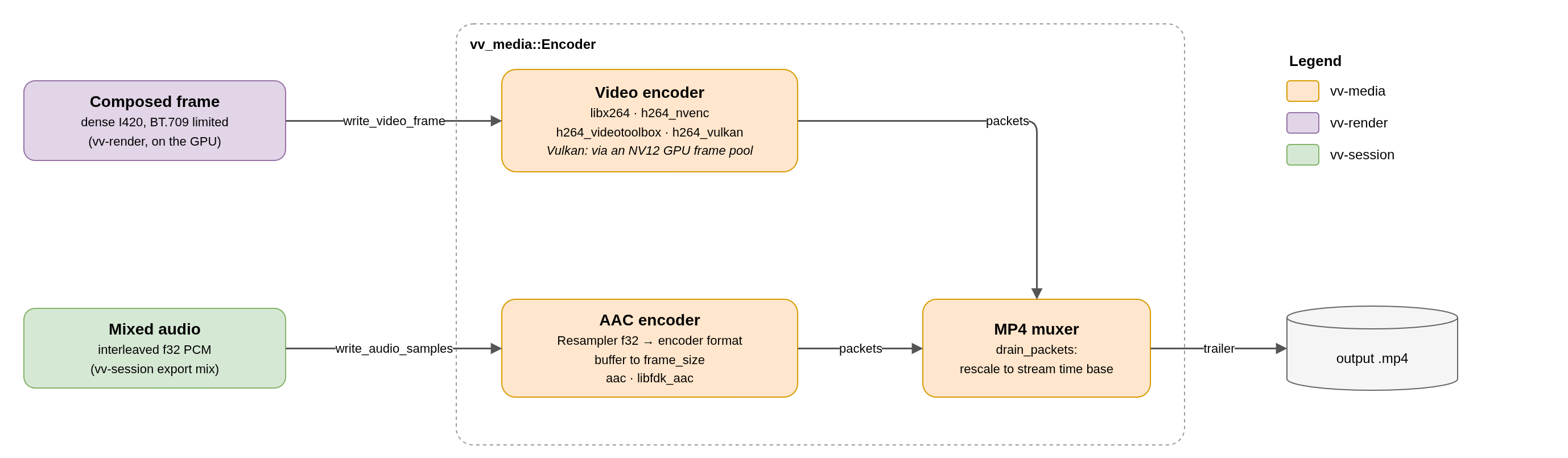
Video encoders
| Codec | Quality control (default) |
|---|---|
| libx264 | CRF (20), preset superfast |
| h264_nvenc | VBR with cq (20), preset p5 |
| h264_vulkan | constant QP (23), NV12 GPU frames |
| h264_videotoolbox | constant quality 1–100 (65), macOS only |
Output is always tagged BT.709 limited range. NVENC is preselected when it is available; otherwise x264.
Availability check
An encoder compiled into FFmpeg may still be unusable (NVENC without an NVIDIA GPU, a Vulkan driver without an encode queue, an encoder that drops a chroma plane). VideoCodec::is_available therefore encodes five frames of a known color, decodes them back and compares Y/U/V within ±4. The result is cached; availability() runs the check on a thread so the export dialog never blocks.
Audio
Native aac (optionally the faster "fast" coder) or libfdk_aac when FFmpeg has it, 128 kbps by default. Samples are buffered until a full encoder frame is available.
No comments to display
No comments to display