
Shared wgpu Device
The editor window and the viewer share one wgpu device: the composed frame is a texture that egui samples directly, with no copy to the CPU. Work that must not compete with the UI gets its own headless device.
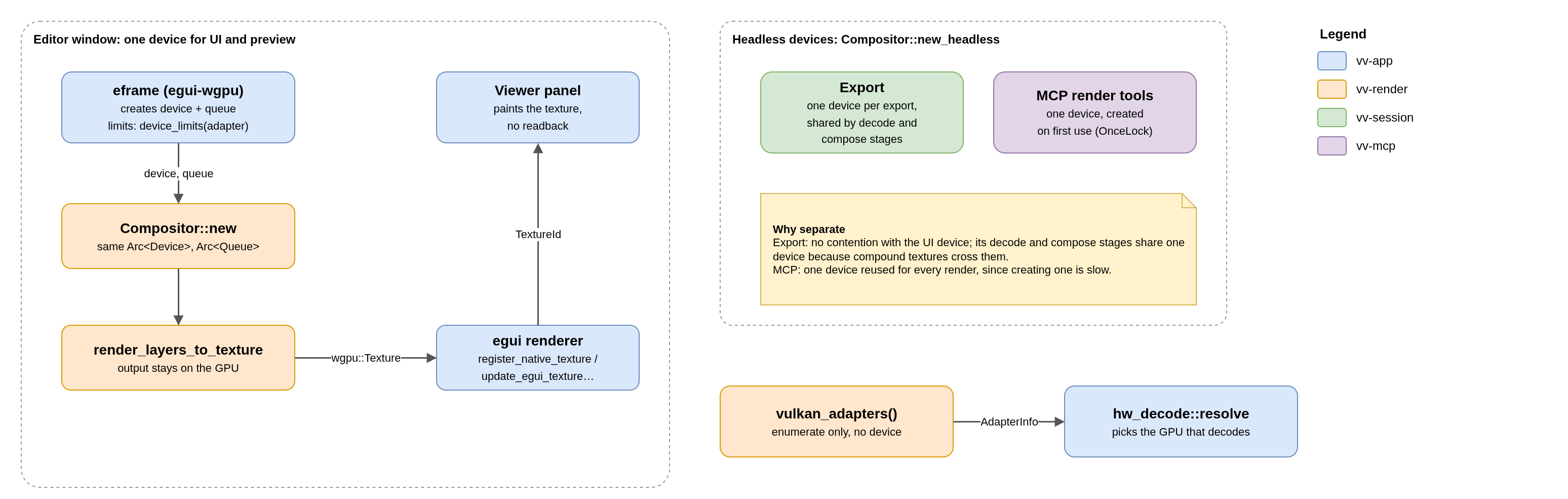
Devices in the process
| Device | Created by |
|---|---|
| UI + preview | eframe at window creation; Compositor::new receives the same device and queue (and the adapter, asked whether it can compose in 16-bit float). Required by render_layers_to_texture, whose texture egui registers as a native texture. The Color window's Scopes use it too, since they read the compositor's textures. |
| Export | Compositor::new_headless_with_precision, one per export, at the project's precision. The decode and compose stages share it because a compound clip's texture is created in one and sampled in the other. |
| MCP renders | One headless compositor, created on first use and switched to each project's precision: creating a device is slow. |
Limits and backends
device_limitsasks for 8192-pixel textures but never more than the adapter offers: wgpu refuses a device that exceeds them, and small GPUs (e.g. Raspberry Pi 4) have lower defaults.- Backends come from wgpu: Vulkan on Linux, Metal on macOS.
vv_render::vulkan_adapters()only enumerates the Vulkan adapters without opening them; the HW decode setting uses it to choose which GPU decodes (see Decode & HW Acceleration).wgpuis re-exported so callers use the same version as the compositor.
No comments to display
No comments to display