Frame Provider
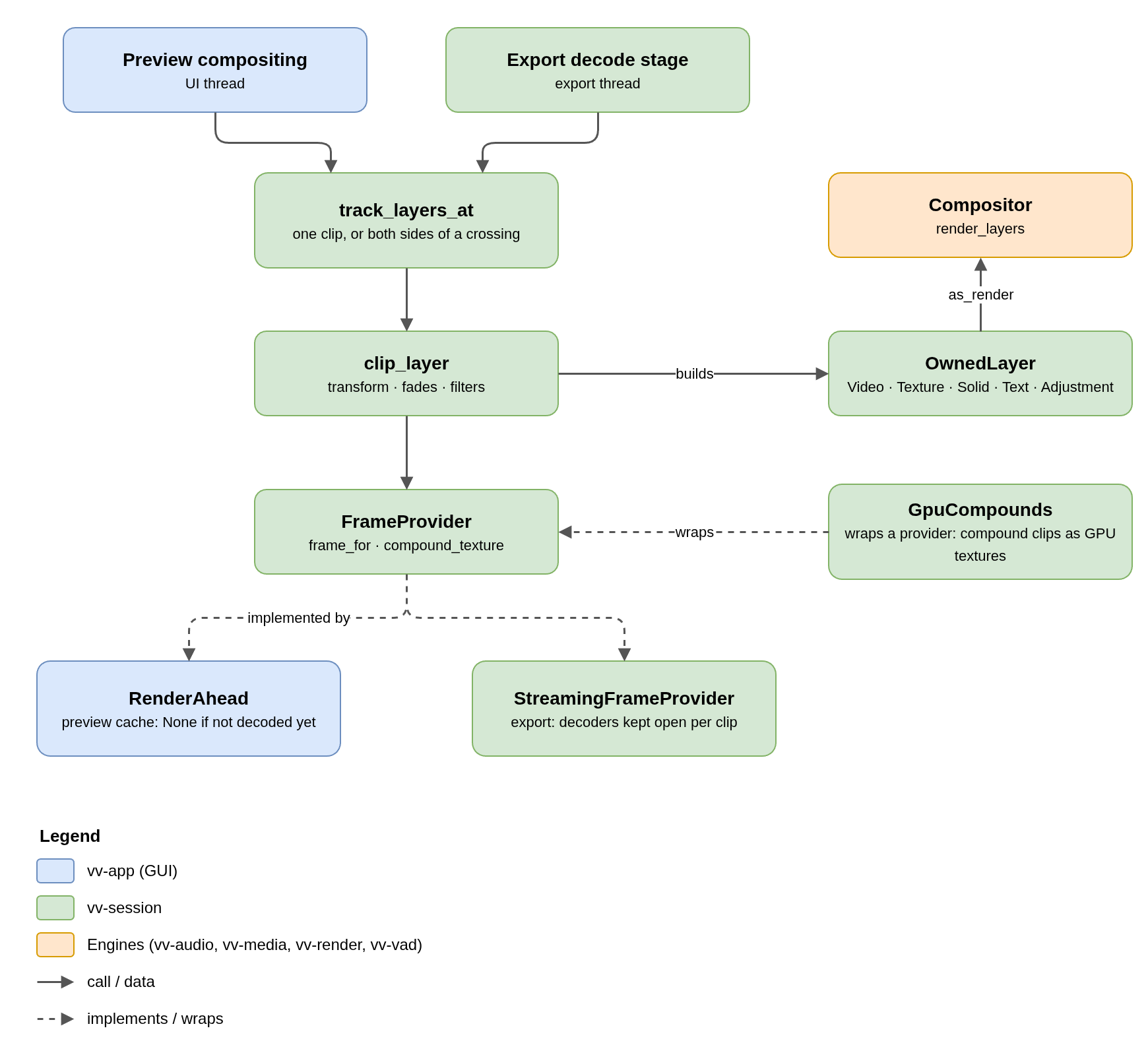
frame_provider.rs holds the one mapping from a clip at a timeline frame to what the compositor draws. Preview and export share it and differ only in how they obtain decoded frames, which is the FrameProvider trait.
The trait
| Method | Contract |
|---|
frame_for | Ok(None) means not available now: not cached yet (preview), or past the end of the file (export). A decode error stays Err, so export never turns it into a silent black frame. |
compound_texture | The composed frame of a compound clip's nested timeline as a GPU texture. The default returns None, and the caller falls back on frame_for (composed and read back to the CPU). |
Implementations
| Type | Used by |
|---|
RenderAhead (vv-app) | Preview. Reads the timeline frame cache filled by the render-ahead decode thread. |
StreamingFrameProvider | Export. Keeps one decoder open per clip and seeks only when the clip changes; every seek flushes to a keyframe, too slow to do per frame. It marks every clip it is asked for and, once a frame is decoded, closes the decoders of the others (sweep), nested and crossing clips included. |
GpuCompounds | Wraps either one. Composes compound clips recursively on the GPU so the texture stays on the card instead of a round trip through CPU and YUV. |
Building layers
track_layers_at is the entry point for a whole track. It returns one layer, or two inside a crossing transition (tail of the left clip, then head of the right one).clip_layer evaluates the keyframed transform at the source frame, adds the transition push and the fade opacity, and attaches the active filters and blend mode.- A nested timeline whose clips are still decoding gives no frame: a half-composed frame would be worse than none.
OwnedLayer owns what vv_render::Layer borrows (Video, Texture, Solid, Text, Adjustment). vv-render does not depend on vv-media, so video frames are passed as raw YUV planes (as_render_yuv_frame).

No comments to display
No comments to display